
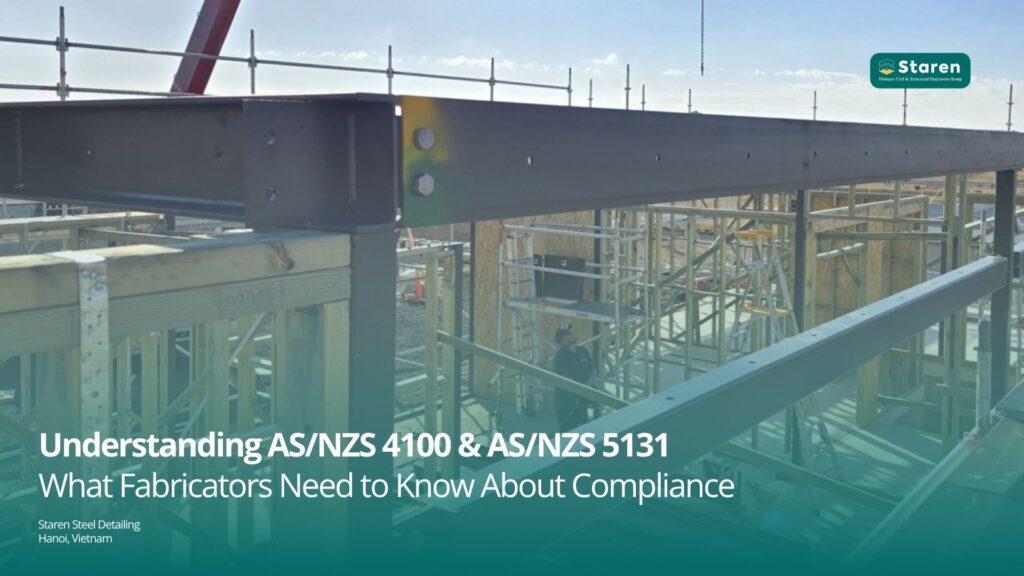
For structural steel fabricators across Australia, navigating regulatory compliance can often feel like aiming at a moving target. However, under the National Construction Code (NCC), compliance for steel structures is crystal clear and hinges on two inseparable companion standards: AS 4100 (Design) and AS/NZS 5131 (Fabrication and Erection).
Recent mandates explicitly tie these two together: all fabrication and erection work designated under AS 4100 must be completed in strict accordance with AS/NZS 5131.
If your workshop fabricates structural steel for the Australian residential house market, understanding this relationship is non-negotiable for passing engineering inspections and avoiding costly site reworks.
AS 4100 vs. AS/NZS 5131: What is the Difference?
To stay compliant, a project must pass seamlessly through design, fabrication, and erection. The responsibilities are split between the engineer’s desk and your workshop floor:
- AS 4100 (Steel Structures Design Standard): This is the “constitution” of steel design. It governs how structural engineers analyze loads, calculate lateral-torsional buckling, and verify the safety limits of steel members and connection types.
- AS/NZS 5131 (Structural Steelwork—Fabrication and Erection): This is the execution standard. It dictates the practical benchmarks for the physical creation of the steel. It regulates welding qualifications, cutting tolerances, surface preparation (like hot-dip galvanizing), and material traceability.
The Golden Rule: The capacity calculations an engineer makes under AS 4100 assume that the steel is fabricated exactly to the quality metrics outlined in AS/NZS 5131. If your shop drawings or fabrication tolerances drift, the engineer’s design compliance is completely compromised.
The Risk Matrix: Understanding Construction Categories (CC)
AS/NZS 5131 introduces a risk-based approach known as Construction Categories (CC). The project engineer dictates the CC level based on the consequence of structural failure, but as a fabricator, you must execute your work to match that exact category.
For residential house jobs, fabricators typically encounter two primary levels:
| Construction Category | Project Types | Quality Control & Inspection Needs |
| CC1 (Low Risk) | Basic residential carports, simple retaining walls, agricultural sheds, and minor outbuildings. | Minimal. Visual testing (VT) of welds is generally sufficient; basic document control. |
| CC2 (Medium Risk) | Standard residential homes, multi-story townhouses, complex custom architectural builds, and commercial offices under 15 storeys. | Strict. Mandates full material traceability (mill certs), documented Welding Procedure Specifications (WPS), and non-destructive weld testing (NDT/ultrasonic). |
Most modern custom residential house jobs with complex structural steel layouts fall under CC2. This means you must prove material traceability and exact dimensional compliance before the steel frames leave your workshop floor.
Why Compliance Starts with Accurate Steel Detailing
You cannot fabricate a code-compliant steel assembly from flawed blueprints. Every beam, cleat, bolt-hole spacing, and weld symbol must be accurately translated from the engineer’s structural drawings into fabrication-ready shop drawings.
High-quality 3D steel detailing ensures compliance by:
- Enforcing Geometrical Tolerances: Ensuring that your workshop assemblies meet the tight physical limits mandated by AS/NZS 5131.
- Explicit Welding Specifications: Clearly mapping out joint preparations and weld types so your certified welders execute exactly what is required under AS/NZS 1554.
- Preventing On-Site Rework: High-precision shop drawings mean no field cutting, no field welding adjustments, and zero council defect notices when the steel arrives on site.
Safeguard Your Next Aussie Residential Job with Staren Group
Ensuring absolute compliance with AS/NZS 4100 and AS/NZS 5131 doesn’t have to strain your internal overheads.
At Staren Group, we specialize in providing premier, code-compliant structural steel detailing and shop drawings tailored specifically for the Australian residential housing market. Headquartered in Hanoi, Vietnam, our elite team of structural draftsmen and technical engineers utilizes advanced 3D BIM software (including Tekla Structures and Autodesk Advance Steel) to generate flawless, millimeter-accurate drawings that align strictly with Australian Standards.
Whether you are fabricating a complex portal frame for a knockdown rebuild or steel lintels for a multi-unit townhouse development, we deliver the precision data your workshop needs to maintain seamless compliance, cut material waste, and win bigger tenders.
📞 Let’s Build with Confidence. Get a Free Quote Today:
- 🏢 Corporate Office: 282 Nguyen Huy Tuong Street, Thanh Xuan District, Hanoi, Vietnam
- 🌐 Website: www.starengroup.com
- 📧 Email: staren.vietnam@gmail.com
- 📞 Phone/WhatsApp: 0084 345 868 010
Australia Steel Frame house
Sydney, AU
Australia Steel Frame house
Sydney, AU
Enix Lawyer Building
Toronto, CA
Deep Sea Bridge
Athens, GR
Car Tech Building
Denver, USA
Nuctech Building
Texas, USA